 OdoMate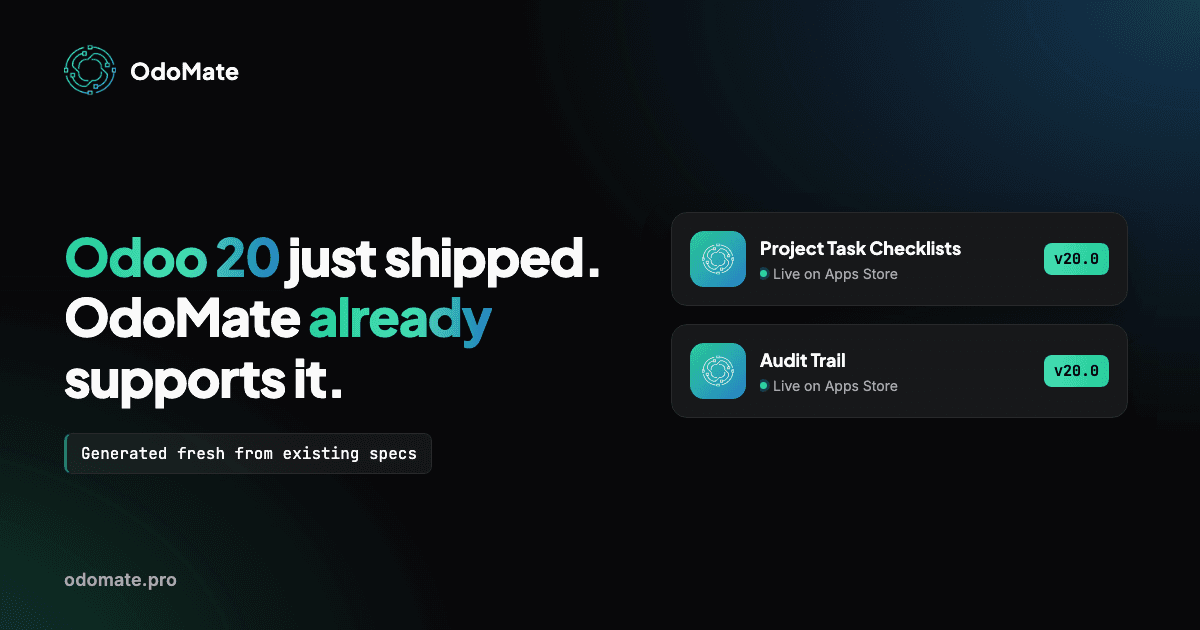
Yes — OdoMate's generation engine now targets Odoo 20, the version Odoo shipped September 24, 2026, at Odoo Experience in Brussels. That's not a roadmap promise: the platform has already produced two live modules on it, Project Task Checklists and Audit Trail, both on the Apps Store at version 20.0, generated fresh from existing specifications, not ported by hand.
What that means, in short:
- OdoMate's generation engine now targets Odoo 20 — the platform isn't limited to last year's version; it keeps pace with new Odoo releases.
- Proof, not a promise: Project Task Checklists and Audit Trail are both already live at 20.0 on the Apps Store, generated fresh from existing specifications.
- Neither build is a migration of an existing install — that capability is roadmap, not shipped.
- Odoo 20 (Community and Enterprise) launched at Odoo Experience, Brussels, September 24, 2026.
What just shipped at Odoo Experience
Odoo 20 — Community and Enterprise together, as every annual release ships — was unveiled at Odoo Experience in Brussels, September 24–26, 2026, per Odoo's own release notes. A few of the headline changes, straight from Odoo's own release notes:
- An offline mode that lets records be created and edited without a live connection.
- AI agents that update themselves for their specific use case.
- An accounting flow that pays bills straight from Odoo.
- A visual refresh replacing Font Awesome icons with Material Symbols.
We're not going to re-run the full feature list here; plenty of coverage already exists for that. What's relevant to this post: a new major version means every custom and community module now has to prove it still works against the new one.
Why does a new Odoo version usually mean a wait?
A module built for 19.0 isn't automatically a module that runs on 20.0. Odoo's APIs, view syntax, and internal conventions shift release to release, and someone has to re-test — sometimes rewrite — the module against the new version before it's safe to install. For a module you built in-house, that someone is your own team, whenever they get to it. For a module you installed from the Apps Store or OCA, it's whoever maintains it, on their own schedule. Either way, the common experience is a real wait, often weeks, between a new Odoo version shipping and the modules a Community-edition user actually depends on catching up to it.
This is also why it's worth asking about the platform, not just the module: a generator that stops adding new Odoo versions leaves you exactly as stuck as an unmaintained module would. Whether OdoMate itself keeps building for what Odoo ships next is a fair question — here's the direct answer.
Does OdoMate generate for Odoo 20 yet?
Yes. OdoMate added Odoo 20 as a generation target the same week it shipped — any specification can be generated against 20.0 now. Two modules already show it:
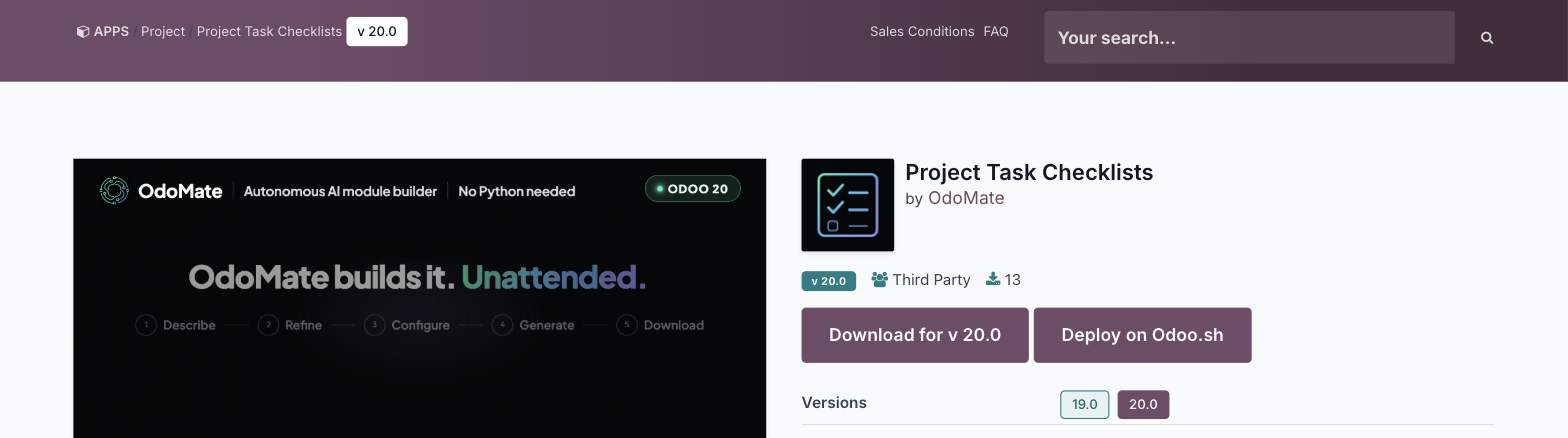
Project Task Checklists — reviewed here in July — is live at odomate_project_checklist, version 20.0. The 20.0 listing is the same module, the same specification, generated and automatically tested by OdoMate against the new version's requirements.
The second isn't new, either — it's Audit Trail (audit_trail, version 20.0), a module that keeps a per-company history of who created, changed, deleted, exported or opened the records you choose to watch, with before/after values on every change. It was already generated and tested against Odoo 19 before this, as part of an internal comparison exercise; what's new here is the same specification reaching Odoo 20, with 29 automated tests. Same story as the checklist module: not a brand-new idea rushed out for the release, a spec that already existed, generated fresh on the version that just shipped.
Does this mean OdoMate upgrades an existing v19 install to v20?
No — and it's worth being precise here rather than letting the headline do more work than it should. What shipped is generation on Odoo 20: OdoMate produced a 20.0 build from the specification, the same way it already produces a 19.0 build from that same specification today. It did not take an existing, installed 19.0 database and migrate its code or its data forward to 20.0. That's a different capability — an in-place upgrade path — and it's on our roadmap, not something OdoMate ships yet.
| Generation on the current version (shipped) | Migrating an existing install (roadmap) | |
|---|---|---|
| What happens | A fresh module is generated from the specification, targeting the new version | An existing installed module's code and data are carried forward to the new version |
| What you get today | A 20.0 build you can install fresh, e.g. on a new database | Not yet available |
| What it depends on | Having the specification on file | Reading and transforming an existing installation's state |
If your own custom module was generated by OdoMate, the path today is: keep the specification, regenerate against the new version when you're ready to move. That's not nothing — it's the same effort as writing the spec once, reused — but it isn't an automatic in-place upgrade, and we'd rather say that plainly than let "already on Odoo 20" imply more than it does.
What should you do if your own module isn't updated for Odoo 20 yet?
The proof above is about the generation engine, not just about these two modules — the same capability applies to whatever you'd specify next. If your own module isn't ready for Odoo 20 yet, the fix isn't to wait for it — it's to have a specification you can generate from. Unlike an installed module, a written specification doesn't go out of date when a new Odoo version ships. We covered where to start writing one down in an earlier post. The same "generate it, don't wait for someone else to update it" idea has come up before, too — with a discount-approval module.
Inspect the modules, then request early beta access — we review requests on a rolling basis and onboard in small cohorts.
FAQ
Does OdoMate generate modules for Odoo 20? Yes. Odoo 20 is a supported generation target now, the same way Odoo 19 already was — this isn't limited to the two modules in this post; it's a capability of the generation engine itself.
Does OdoMate's Odoo 20 support mean it upgrades an existing v19 module in place? No. OdoMate generates a fresh module on the version you target, from a specification — it does not migrate an already-installed module's code or data from one Odoo version to another. That's a separate, roadmap capability.
Does OdoMate generate for Odoo 20 Enterprise? OdoMate's own target is Odoo Community edition, and neither module depends on anything Enterprise-only — so, like any Community-suitable module, both can also be installed on an Enterprise database. What OdoMate doesn't do is generate a module that specifically requires Enterprise-only functionality; everything it's produced so far only depends on what Community already provides.
How soon after Odoo 20 shipped were the modules live? Odoo 20 was unveiled September 24, 2026. The 20.0 build of Project Task Checklists was live on the Apps Store while Odoo Experience was still running, and Audit Trail published at 20.0 the following day.
Is the checklist module's Apps Store listing the same one reviewed in the July comparison post? Yes — same specification, same module, this time built for 20.0. The July comparison covers the code-level detail; this post is specifically about it reaching the new Odoo version.
Is Audit Trail tested the same way? Yes. It ships with 29 automated tests, generated and run as part of OdoMate's normal workflow — the same process behind the checklist module's 12-case suite in July.
Is a generated module production-ready as soon as it's published? Generated code needs human review before production. OdoMate generates and automatically tests every module as part of its normal workflow, but that test suite validates the module's own defined behavior — it doesn't test against your specific customizations, data, or other installed modules. That's exactly why a human review still matters, and we don't present automated testing as a substitute for it.