 OdoMate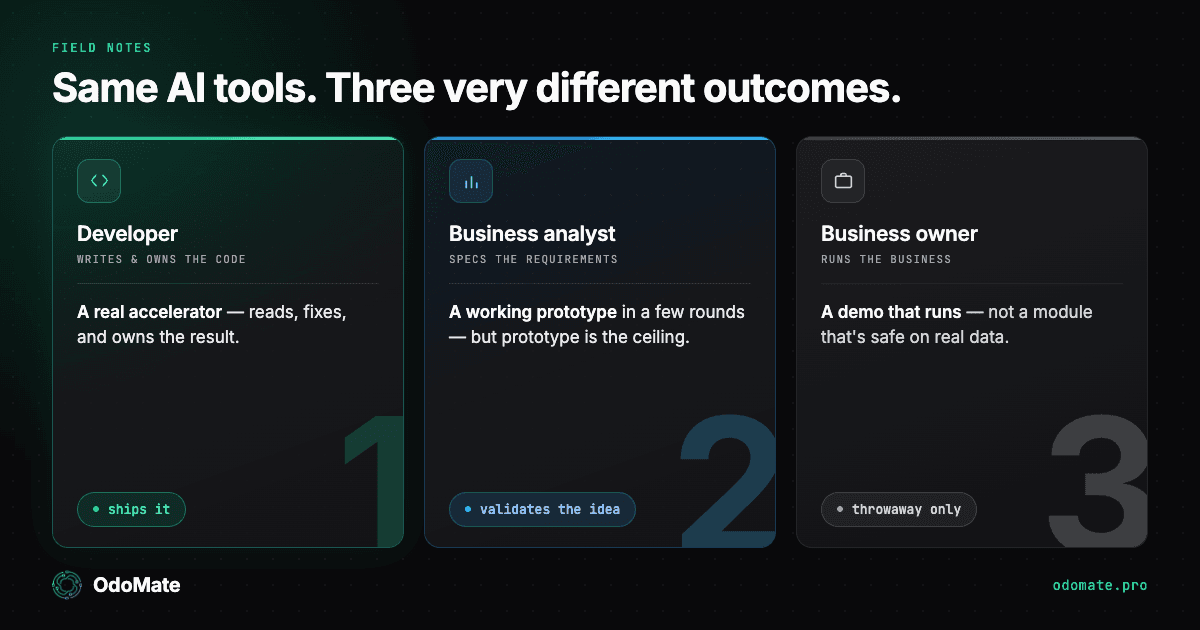
Can you build an Odoo module with AI in 2026? Yes — you can generate an installable Odoo module from a written spec. But who you are decides whether you walk away with a shippable module or a convincing prototype, and production use still needs the same checks either way: version compatibility, access-rights and record-rule review, automated tests, dependency validation, upgrade testing, and human code review. AI can move those checks earlier. It can't move the responsibility off a developer.
That's the honest state of AI-assisted Odoo development this year. Generating code stopped being the hard part. Knowing whether the generated code is safe to run — on real company data, inside Odoo's specific conventions — is now the whole game, and it's exactly the part that doesn't come in the box.
Here's the landscape, by who's actually doing the building — plus a safe, 7-step process at the end.
The 2026 backdrop: mainstream, and quietly distrusted
AI coding tools are no longer fringe. Stack Overflow's 2025 Developer Survey found 84% of developers use or plan to use AI tools, and JetBrains' 2025 ecosystem survey puts regular use around 85%. That part is settled.
What's less advertised is that trust is moving the other way. In the same Stack Overflow survey, the share of developers who trust AI output for accuracy fell from 40% to 29% year over year — and 66% now say they spend more time fixing AI code that's "almost right, but not quite," the failure mode that costs the most, because it looks done.
The security data explains why the skepticism is rational. Veracode's Spring 2026 GenAI Code Security report found that, when the model was given no security-specific guidance, about 45% of AI-generated code samples contained a known security vulnerability — a pass rate that has barely moved in two years, even as the code's syntactic correctness jumped from roughly 50% to 95% over the same window. Read that twice: AI got dramatically better at producing code that looks correct, and roughly no better at producing code that is safe.
So the modern picture isn't "AI writes your module." It's "AI writes something plausible, fast — and someone still has to know whether it's real." Who that someone is changes everything.
Three people, three very different ceilings
The developer gets the most — and still owns the result
A developer working in Cursor, Claude Code, or GitHub Copilot inside their IDE is the best-case user. They can read the output, spot when it silently mixes an Odoo 17 API into an Odoo 19 module, rewrite the query that would have run inside a loop, and add the record rule the generator forgot. For them, AI is a genuine accelerator on scaffolding, boilerplate, tests, and traceback analysis.
Crucially, the responsibility doesn't transfer. The Odoo Community Association's AI policy states it flatly: "The human contributor takes ultimate and absolute responsibility for their contribution," regardless of how it was produced. The developer is fast because they can validate — not because the tool removed the need to.
The business analyst can prototype — but "prototype" is the ceiling
This is where 2026 genuinely changed. A functional consultant or in-house BA can now describe a need, work through a few rounds of prompting, and end up with a rough working draft they can click through. It takes some back-and-forth, not one magic prompt — but getting to something real used to require a developer, and now it doesn't. That's genuinely valuable for validating an idea early.
But the gap between that prototype and a shippable module is exactly the gap the BA can't fully close alone: Are the access rules right? Is there a record rule, or does the module only look secured? Will it survive the next version upgrade? One 2026 audit of naive AI-built apps found zero of twelve features were production-ready — authorization, input validation, and tests sat at zero — even though the apps ran. The prototype is real. So is the ceiling.
The business owner gets a demo, not a dependable module
At the far end is "vibe coding" — a term Andrej Karpathy coined in early 2025 for "fully giving in to the vibes" and forgetting the code exists. Developer-tools writer Simon Willison drew the line the industry now uses: it's fine for low-stakes, throwaway work, but "I won't commit any code I couldn't explain to somebody else."
A non-technical owner can produce something that demos. What they can't do is the review step that decides whether it's safe on real data — and there's no safety net underneath them. The Cloud Security Alliance's 2026 note on the "vibe coding governance gap" makes the point bluntly: none of the major security frameworks offer usable guidance for non-technical people shipping AI-built software without professional oversight. Great for a mock-up. Not something to run your business on.
The short version
| Who's building | What AI gives them today | Where it stops |
|---|---|---|
| Developer (reads the code) | A real accelerator — scaffolding, tests, boilerplate, faster debugging | Nothing is automatic; they still review and own every line |
| Business analyst (functional, non-coder) | A working prototype, in a few rounds of prompting | Can't fully judge security rules, ORM performance, or upgrade safety — prototype, not shippable |
| Business owner (non-technical) | Something that demos | No way to verify it's safe on real data — throwaway only |
Why Odoo, specifically, punishes generic AI tools
Everything above is worse on Odoo than on a generic web app, because Odoo has conventions a general-purpose model doesn't reliably know.
At Odoo Experience 2025, a talk called "Beyond Code Generation" — from Much Consulting, an Odoo partner — made the point practitioners keep making: AI-generated ERP code tends to fail in recognizable ways. It confuses details across Odoo versions, it misses the actual business logic, and worst of all it can fail silently — code that runs but quietly does the wrong thing, which is the most dangerous outcome when it's touching your accounting or inventory. The practical guidance: keep the real business logic human-owned; let AI do the repetitive scaffolding.
You don't need to be a developer to see the pattern in what trips these tools up — the mistake always looks fine and breaks quietly. Three plain-language examples:
- It mixes up Odoo versions. Odoo changes meaningfully from one version to the next (16, 17, 18, 19). A tool trained on all of them at once will confidently write code for one version using pieces of another. It runs — until it doesn't.
- It locks the front door but leaves a window open. Odoo controls access in two layers: who can open a screen (access rights), and which rows of data they're allowed to see (record rules). Generic tools reliably handle the first and forget the second — so a module looks properly secured while quietly showing one customer's data to another. This is the single easiest thing to get "looking done" and dangerously wrong.
- It writes code that's slow or fragile in ways only an Odoo developer would catch — the kind that sails through a quick demo and then buckles once real data and real users hit it.
There's a 2026 development worth naming directly: Odoo has announced Claude Code–based development coming to Odoo.sh, with Claude already connectable to an Odoo.sh project through its GitHub integration — so the AI works against the real codebase. That points somewhere real — for Enterprise, since Odoo.sh is the paid Enterprise cloud and dev platform. The Community world — freelancers, small partners, OCA contributors, self-hosted teams — still points generic tools at Odoo with none of that: no built-in Odoo knowledge, no tests, no demo to click through. For Community, the question is wide open — and that's exactly the gap we built OdoMate to close.
How to build an Odoo module with AI safely (7 steps)
Whatever tool you use, the process is what keeps AI output from becoming a production incident. A workable sequence:
- Pin the target first — Odoo version and edition (Community vs Enterprise). Most silent AI errors start here.
- Write the spec and acceptance criteria before generating — the trigger, actors, data, states, notifications, and the edge cases. Vague request in, vague module out.
- Generate in a separate branch or environment, never straight against production.
- Review the security layer by hand — access rights and record rules — and log in as each role to confirm what it can actually see.
- Run the automated tests and read what they actually cover — some are genuinely useful, some are boilerplate.
- Test install and upgrade on a clean database and on a copy of your real one.
- Human code review before production — the step none of the tools remove.
An Odoo-specific pipeline can do several of these for you (steps 3–5 especially). It still doesn't replace step 7.
Where OdoMate fits
Every gap above is exactly what we set out to close — for Community.
The frontier model is no longer where the advantage lives — Enterprise users already have Cursor and Claude Code within reach. So OdoMate isn't a better model; it's the Odoo-Community-specific layer around one. Concretely, from a plain-language spec it produces:
- an OCA-aligned Odoo 19 module — laid out and named the way an experienced Odoo reviewer expects, so it drops into a real project cleanly instead of arriving as loose code a general tool would emit;
- automated tests, generated and run as part of the workflow — the step BAs and owners can't do by hand;
- a live demo with test users at every permission level — so the "locked front door, open window" trap from above is something you see, by logging in as each role, instead of hoping;
- the module already translated into your language — OdoMate can generate the interface translation files (
.po) along with the module, in any of 19 languages besides its English default, so you're not translating labels by hand afterward; - an auto-generated user guide, and a profile system (Business / Functional / Technical) so a non-developer can describe what they need precisely without knowing Python.
We've already published one module built exactly this way — Project Task Checklists — live on the Odoo Apps Store with its full source on GitHub, and we'll keep publishing more, so you can judge for yourself that the quality is consistent, not a one-off. A second one, a sale discount approval module, is written up too — including the feature the generator declined to build, and why. It came out of the generator with a 12-case automated test suite, an OCA-aligned structure, and a proper user/manager access split with record rules. Reviewed file-by-file against a community module with more than 3,000 installs that does the same job, the core features were a genuine tie — we broke that comparison down in detail in our head-to-head write-up. You don't have to take our word for it — the code is right there to read.
The honest boundary is the same one this whole piece has argued for: a developer should still review the result before production. OdoMate doesn't remove that step — it moves the starting line. Instead of a vibe-coded prototype missing its tests and security, the reviewer opens a module that already ships with them. For a Community team without an Enterprise AI setup, that's the difference between "a draft to argue with" and "a module to check."
FAQ
Can you build an Odoo module with AI in 2026? Yes — from a plain-language spec you can generate a working, tested Odoo module without writing code. But the output should be reviewed by a developer before production, especially its security logic. How close it gets to shippable depends on the tooling: a generic AI assistant produces a prototype; an Odoo-specific pipeline produces a module that already includes tests and OCA structure.
Why do generic AI tools struggle with Odoo? Odoo has version-specific conventions (frameworks and APIs change across 16/17/18/19), a two-layer security model (access rights plus record rules), a manifest with strict dependencies, and ORM patterns that punish naive code. General-purpose models trained on mixed-version data confidently produce plausible-but-wrong Odoo code — confusing versions, and failing silently rather than loudly.
Doesn't Odoo already have AI built in? Two different things. Odoo's native AI features, and its announced Claude Code–based development for Odoo.sh, target Enterprise — in-app assistants and, on Odoo.sh, AI-assisted development against the real project. Odoo Community has no native AI development context, which is the gap tools like OdoMate address.
Is AI-generated Odoo code safe to run in production as-is? Treat it as strong scaffolding that needs a technical review first — the security layer especially. Industry data backs this: when given no security guidance, roughly 45% of AI-generated code carries a known vulnerability (Veracode, 2026), and that number has stayed flat for two years even as functional correctness soared.
What's the difference between a prototype and a shippable module? A prototype runs and demos. A shippable module also has correct access rights and record rules, real tests, valid manifest and dependencies, and survives an upgrade — the parts that are invisible in a demo and are exactly where AI output most often falls short.
Building on Odoo Community and curious how this works on a spec of your own? OdoMate is in early beta — we review requests on a rolling basis and onboard in small cohorts.
Prefer to start with the spec itself? Grab the free Odoo Module Spec Template.